
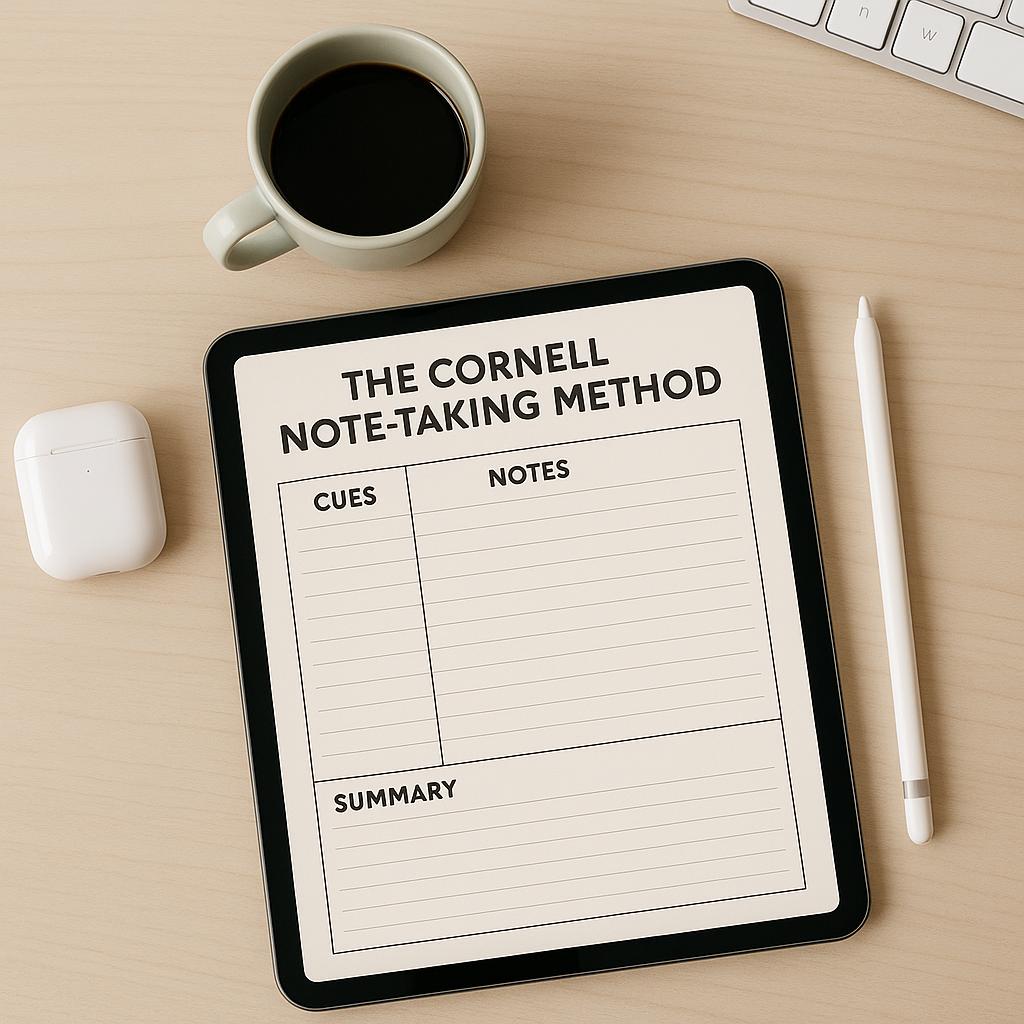
You’ve filled notebooks, highlighted articles, and scribbled across margins—but when it’s time to recall information, your memory falls flat. Sound familiar?
If so, you might not need more notes—you need better ones.
The Cornell Note-Taking Method was developed in the 1940s by Walter Pauk, an education professor at Cornell University. It’s one of the most reliable, research-backed formats for retaining, reviewing, and applying what you learn.
Whether you’re a student preparing for exams, a professional navigating meetings, or a lifelong learner consuming complex content, this method helps you break information down in a way your brain can process and remember.
What Is the Cornell Note-Taking Method?
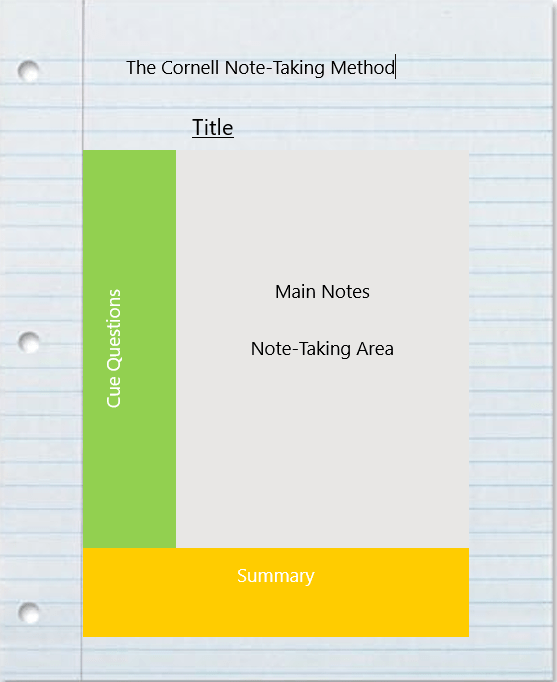
At its core, this method is a structured layout divided into four key sections:
- Cue Column (Left side)
Use this narrow column to jot down keywords, main ideas, or questions that relate to the notes on the right. - Note-Taking Area (Right side)
This is where you capture the bulk of the information—facts, explanations, bullet points, and diagrams during a lecture, meeting, or reading session. - Summary Section (Bottom)
After the session ends, take a moment to summarize the key takeaways in your own words. This helps cement the material in your memory. - Title and Date (Top)
Always title your notes and date them to make future review faster and more effective.
This layout not only encourages active listening but also supports deeper learning through review and reflection.
Who Is It For?
The Cornell Method is highly adaptable, making it suitable for a wide range of users:
- Students: Especially effective for subjects that require conceptual understanding (like history, biology, or psychology).
- Professionals: Great for summarizing client meetings, workshops, or presentations.
- Researchers and Readers: Helps condense large volumes of reading into digestible chunks.
- Visual and Reflective Learners: Encourages spatial organization and reflective thinking.
How to Use It in Different Contexts
1. In School or Lectures
- Listen actively during the lesson, jotting main points in the right-hand column.
- Fill the cue column with related questions or key terms after class.
- Summarize at the end of the day to reinforce learning.
Bonus tip: Use your cue column to quiz yourself later without looking at the full notes.
2. During Studying
- Review previous notes using the cue column to test recall.
- Rewrite or expand summaries to reinforce understanding.
- Use color coding for categories (theories, examples, definitions).
3. In Meetings
- Capture speaker quotes, action items, or decisions on the right.
- Fill the cue column with team member names, project references, or follow-up questions.
- Summarize next steps at the bottom to clarify responsibilities and keep alignment.
4. For General Note-Taking and Learning
- Use for podcasts, books, webinars, or any form of knowledge intake.
- It’s especially helpful for ongoing projects where clarity and structure are essential.
- Keep a digital or physical Cornell-style notebook to build a consistent habit.
Why It Works
The Cornell Method supports several powerful learning principles:
- Active Recall: By summarizing and questioning, you strengthen memory retention.
- Spaced Repetition: Re-reviewing structured notes enhances long-term retention.
- Cognitive Load Reduction: Breaking info into columns makes it less overwhelming.
- Reflection: Summaries force you to process information, not just record it.
Studies have shown that learners using structured note-taking strategies like the Cornell Method outperform their peers in comprehension and retention. It’s not just about what you record—it’s how you engage with it.
Getting Started
You can start today with nothing more than a notebook and a pen. Or, you can print Cornell note templates, use apps that support the layout, or even draw a quick grid before a meeting or class.
Here’s a quick format:
- Left margin: 2.5 inches (Cue)
- Right side: 6 inches (Notes)
- Bottom section: 2 inches (Summary)
With regular use, this method trains your brain to capture, distill, and retain information more effectively.
Conclusion
The Cornell Note-Taking Method offers more than just a clean page—it offers a system for learning with intention. Whether you’re tackling textbooks, leading a meeting, or reflecting on a podcast, the structure keeps your thinking clear, focused, and productive.
If you’re serious about improving how you capture and retain information, it’s one of the smartest tools to add to your toolkit.
Want to explore other methods like this? Check out the full series:
👉 Mastering the Art of Note-Taking: The Best Methods for Retaining Information
Follow us on Instagram, LinkedIn, Pinterest, and Facebook for more productivity tips and tools. And don’t forget to sign up for our newsletter to get exclusive resources and updates straight to your inbox!









Leave a comment