
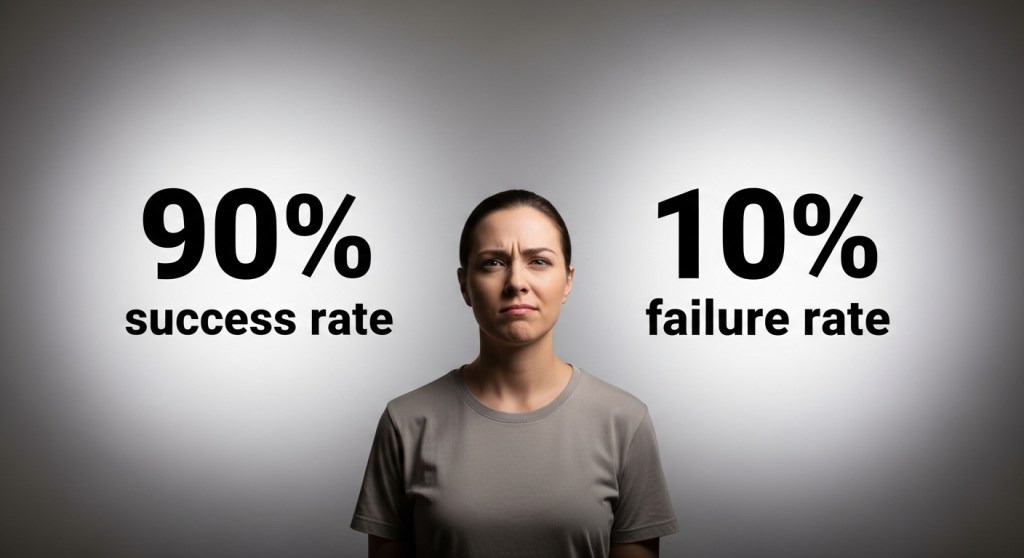
You read that a medical treatment has a ninety percent success rate. You feel calm and hopeful. Then you read that the same treatment has a ten percent failure rate. Suddenly you feel uneasy. The facts did not change. Only the wording did. Yet your reaction shifted.
This is the framing effect.
As a psychologist, I define framing as the way information is presented and how that presentation shapes decisions, emotions, and behavior. The same data can lead to very different choices depending on whether it is framed as a gain or a loss, a benefit or a risk, a success or a failure.
What framing really means
Framing happens when our mind reacts more to the context of information than to the information itself. We do not process facts in a neutral way. We interpret them through emotional and cognitive filters.
Research shows that people are more willing to take risks to avoid losses than to achieve gains. This means that negative frames often push stronger reactions than positive ones.
For example, people are more likely to choose a surgery if the outcome is framed as survival rather than death. Both statements describe the same result, yet decisions change.
Framing in professional life
In the workplace, framing influences motivation, performance, and collaboration.
If a task is framed as a chance to learn, people approach it with curiosity. If it is framed as a risk of failure, anxiety rises and creativity drops.
Feedback is another strong example. Saying this report needs improvement creates a different response than saying this report has strong potential. Both can lead to growth, but one creates pressure while the other builds confidence.
In home office settings, self framing matters even more. When you tell yourself I have to finish this, stress increases. When you say I get to work on this, energy shifts.
Framing and studying
Students experience framing every day.
A test can be framed as a threat or as a chance to show progress. When framed as a threat, fear blocks memory and focus. When framed as progress, learning improves.
Mistakes can be framed as proof of failure or as part of learning. The second frame supports persistence and deeper understanding.
Even study plans benefit from framing. Saying I must study three hours sounds heavy. Saying I will focus deeply for three short sessions feels lighter and more doable.
Framing in daily life decisions
Framing shapes everyday choices more than we realize.
Marketing uses framing constantly. Discounts framed as saving money feel better than the same price framed as spending less.
News headlines use framing to shape emotional response before facts are processed.
Health advice framed as avoiding illness often motivates differently than advice framed as gaining energy or strength.
Why the brain responds to frames
From a psychological view, the brain uses shortcuts to manage complex information. Framing provides meaning quickly. It reduces mental effort, but it also increases bias.
Emotion and language are deeply linked. The words we use create emotional signals that guide decisions faster than logic.
This is why awareness is critical. When you notice the frame, you regain choice.
How to reframe for better outcomes
Start by noticing your inner language. Small changes in wording create large changes in behavior.
Reframe stress as preparation. Reframe mistakes as feedback. Reframe effort as growth.
In work communication, choose frames that support clarity and motivation.
When facing difficult decisions, actively rewrite the problem in several ways. Ask how does this look as a gain and how does it look as a loss.
This simple step reduces emotional bias and improves decision quality.
Why this matters
Framing explains why intelligent people make inconsistent choices. It shows that logic alone does not drive behavior.
Understanding framing gives you a powerful tool. You gain the ability to design better messages, build healthier self talk, and make more balanced decisions.
This article is part of the series Decision Making and Cognitive Biases. Together, these concepts reveal how hidden forces shape everyday thinking.
Better choices begin when you learn to see the frame before you step inside it.
Explore the full series: How Decision Making Really Works







Leave a comment