
Your brain doesn’t think in lines—it thinks in connections.
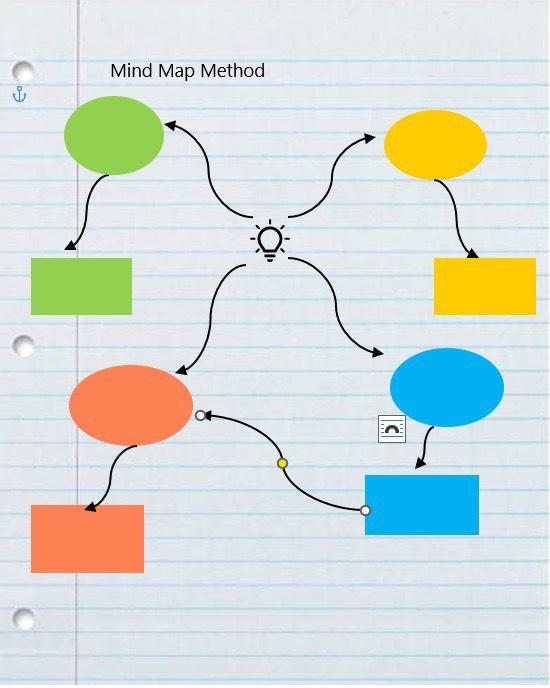
That’s the core idea behind the Mind Map Method, a visual note-taking approach that mirrors how we process and recall information. Instead of lists, you use branches, keywords, colors, and images to create a map that radiates from a central idea. It’s not only more engaging than traditional methods—it’s often far more effective.
What Is the Mind Map Method?
A mind map starts with one main topic at the center. From there, subtopics branch outward, each with related ideas, questions, or data. You can expand or collapse these branches depending on how detailed your exploration becomes.
It’s a technique championed by Tony Buzan and supported by cognitive science: visual learning and spatial awareness enhance memory and engagement by activating multiple areas of the brain.
Who Should Use This Method?
Mind mapping is especially helpful for:
- Visual learners who retain images better than text
- Creative thinkers who enjoy seeing the big picture
- Students who need to break down complex concepts
- Professionals during brainstorming, presentations, or project planning
- Anyone struggling with focus or linear note-taking structures
Using Mind Maps in Different Contexts
In School
Use mind maps to summarize textbook chapters or lecture topics. It helps clarify the hierarchy of ideas and improves exam prep by showing how concepts interrelate.
During Studying
Rewriting your notes into mind maps activates recall and understanding. You’re forced to rephrase, reorganize, and visualize, which deepens learning.
In Meetings
Mind maps offer a flexible way to record meeting topics and decisions without following a rigid structure. Start with the agenda and let the discussion grow organically around it.
For General Note-Taking and Learning
Whether you’re learning a new skill, preparing for a presentation, or problem-solving, mapping your thoughts uncovers patterns and gaps quickly.
How to Start Your First Mind Map
- Central Idea – Write or draw it in the middle.
- Main Branches – Create categories or questions related to the topic.
- Keywords – Use single words or short phrases per branch.
- Colors & Icons – Use visual elements to improve memory and attention.
- Flexibility – Add and shift ideas as needed—there are no wrong paths.
Final Thought
Mind maps don’t just capture information—they reveal it. They help you see how thoughts connect, rather than burying them in paragraphs. Whether you’re a student, creative, or strategic thinker, this method can reshape how you process and retain knowledge.
Want to explore more techniques like this? Visit the full guide:
Mastering the Art of Note-Taking: The Best Methods for Retaining Information
Follow us on Instagram, LinkedIn, Pinterest, and Facebook for more productivity tips and tools. And don’t forget to sign up for our newsletter to get exclusive resources and updates straight to your inbox!








Leave a reply to Mastering the Art of Note-Taking: The Best Methods for Retaining Information – Roya Bloom Cancel reply