

There’s something surprisingly powerful about a small square of paper. Sticky notes may seem simple, but when used intentionally, they can become one of the most versatile and effective tools for capturing, organizing, and engaging with information.
This method isn’t just about jotting reminders. It’s about visually mapping your thoughts, making connections, and staying agile—whether you’re in school, studying for exams, in meetings, or just organizing your ideas on the fly.
What Is the Sticky Note Method?
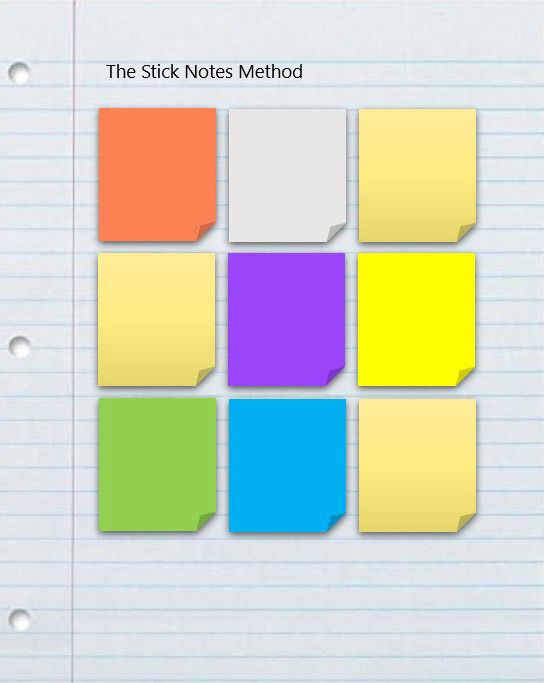
The Sticky Note Method uses small, movable notes to capture bite-sized pieces of information. These notes can then be grouped, reordered, color-coded, layered, or removed entirely. It’s a dynamic, non-linear approach to note-taking that works particularly well for people who learn best by doing, seeing, and moving ideas around.
Who Benefits Most From This Method?
This method is especially helpful for:
- Visual learners who like to see patterns and connections
- Kinaesthetic learners who benefit from physically manipulating ideas
- Creative thinkers and strategic planners
- Students who prefer flexibility over structure
- Teams brainstorming ideas or planning workflows
- Anyone who feels overwhelmed by rigid note formats or large blocks of text
How to Use the Sticky Note Method in Different Contexts
🏫 In School
- Use sticky notes to break down complex topics into smaller concepts.
- Create color-coded categories for themes, vocabulary, timelines, or key questions.
- Rearrange notes on a whiteboard or notebook to explore how ideas connect.
- Ideal for subjects like literature, history, and science where pattern recognition matters.
📚 During Studying
- Write one fact, idea, or concept per sticky note.
- Quiz yourself by hiding parts of a sequence or mixing them up and rearranging.
- Map out an essay structure with sticky notes and move points around until it flows.
- Use a wall or window as a visual study board to stay engaged and mobile.
💼 During Meetings
- Use sticky notes for live idea capture—assign one note per topic or task.
- Group ideas by theme or priority in real time.
- At the end of the meeting, convert sticky notes into action items or transfer them to a digital tool.
- Helps teams avoid getting stuck in endless talk—when a note goes on the wall, it gets addressed.
✍️ For General Note-Taking and Learning
- Sticky notes can work as flexible placeholders when you’re gathering fragmented ideas.
- Move them into mind maps, storyboards, or timelines.
- Use them on physical planners, calendars, or notebooks to mark important notes without committing to a specific layout.
Techniques to Maximize the Sticky Note Method
- Color Coding
Use different colors to indicate categories like tasks, questions, facts, or ideas. This helps you identify patterns faster. - Zoning
Designate areas (on a wall, board, or desk) for certain types of notes: ideas, next steps, roadblocks, or categories. - Layering for Depth
Stack notes or group them to show hierarchy or progression—like major themes and subpoints. - Limit to One Idea per Note
Keeping each note focused allows you to easily rearrange and analyze your thoughts. - Take a Photo Before You Reset
When you’re done working with a layout of sticky notes, take a photo to preserve the arrangement for later reference.
Final Thoughts
Sticky notes offer more than convenience—they offer creative control. The method invites movement, visual mapping, and active engagement with information. It’s adaptable, fast, and low-pressure. Best of all, it works across learning styles, disciplines, and settings.
If your current note-taking system feels too rigid or overwhelming, try replacing your notebook—just for a while—with a stack of sticky notes. You might be surprised how much clarity comes from thinking on paper, one small square at a time.
Explore More Note-Taking Strategies
If you’re curious to discover which method suits your learning or working style best, don’t miss our complete guide:
Mastering the Art of Note-Taking: The Best Methods for Retaining Information
This article dives into the science behind retention, compares popular techniques, and helps you build a personalized system for school, work, or everyday learning.
Follow us on Instagram, LinkedIn, Pinterest, and Facebook for more productivity tips and tools. And don’t forget to sign up for our newsletter to get exclusive resources and updates straight to your inbox!









Leave a reply to Mastering the Art of Note-Taking: The Best Methods for Retaining Information – Roya Bloom Cancel reply