
We love success stories. The entrepreneur who started with almost nothing and built a billion dollar company. The investor who made the right decision at exactly the right moment. The athlete who trained harder than everyone else. The CEO who ignored conventional wisdom and transformed a struggling company. Their stories are everywhere, and we naturally want to understand what made them successful so we can apply the same lessons to our own lives and businesses.
But there is a problem with this approach. We tend to study the people who succeeded because they are the people who remained visible. The entrepreneurs who failed are rarely invited onto podcasts to explain their strategy. The companies that disappeared are no longer included in today’s success rankings. The products that failed are removed from the shelves. The investments that went badly are quietly forgotten. We see the survivors, but not the entire population from which they emerged.
This is known as survivorship bias, and it can seriously distort the way we make decisions.
The Success Story That May Be Missing Half the Story
Imagine that 1,000 people start businesses at roughly the same time. Ten years later, 20 of them have built highly successful companies. Those 20 become visible. They write books, give interviews, appear on podcasts and explain the decisions that helped them succeed.
You study those 20 entrepreneurs and discover that 18 of them worked extremely long hours. You might conclude that working extremely long hours is one of the secrets of entrepreneurial success.
But what if 800 of the other 980 entrepreneurs also worked extremely long hours?
Suddenly, the conclusion becomes much weaker.
Working long hours may have been present among many successful entrepreneurs, but it was also present among many unsuccessful entrepreneurs. The characteristic itself therefore does not explain why some succeeded and others did not.
This is the heart of survivorship bias: we look at the characteristics of the survivors and assume those characteristics caused their survival, while ignoring the people who had similar characteristics but did not survive.
The Missing Data Is Often the Most Valuable Data
This is what makes survivorship bias so dangerous. The problem is not necessarily that the information we have is false. The information can be completely accurate and still lead us to the wrong conclusion.
A successful entrepreneur really did work 80 hours a week. A successful CEO really did reject traditional management practices. A successful investor really did make a fortune by following a particular strategy.
The problem is that we do not automatically know whether those behaviours caused the success.
There may be other explanations. Perhaps the company was in the right market at the right time. Perhaps the founder had access to capital. Perhaps the product benefited from a technological change. Perhaps the investor had a different risk profile. Perhaps the leader inherited a strong organization.
Or perhaps hundreds of unsuccessful people did exactly the same thing.
A successful outcome does not automatically prove that the behaviour behind it was the reason for the success.
The Famous Aircraft Example
One of the most famous examples of survivorship bias comes from World War II.
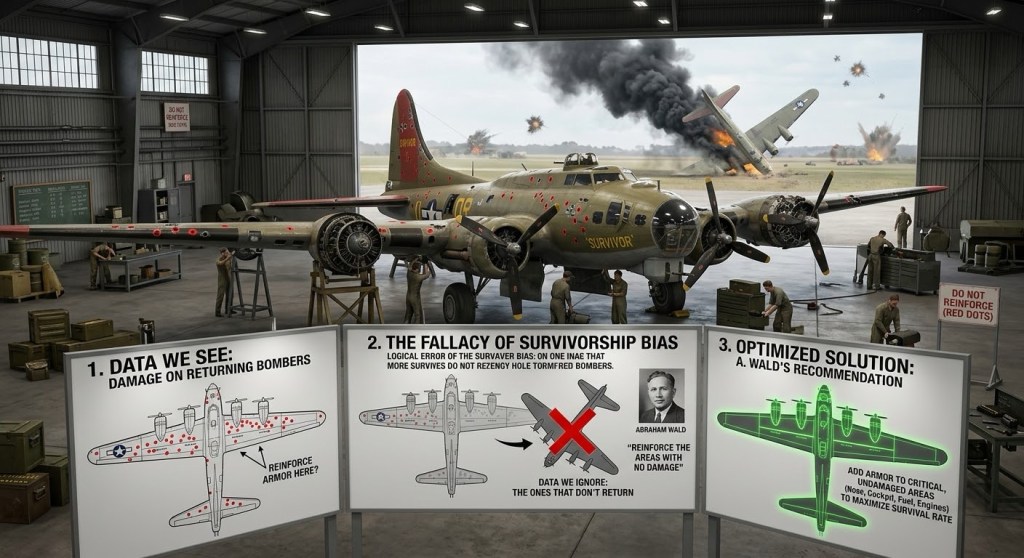
The U.S. military wanted to reduce aircraft losses. Engineers examined planes that returned from combat and mapped where the bullet holes were concentrated. The obvious idea was to add more armor to the areas that had received the most damage.
But statistician Abraham Wald recognized something the analysis was missing.
The planes being examined were the planes that had survived.
The aircraft that had been hit in other areas were not represented because some of them never returned.
That changed the interpretation completely. The areas without damage on the returning aircraft could actually represent the areas where damage was most likely to be fatal.
The important lesson was not simply about aircraft.
It was about data.
What you can observe may be systematically different from what you cannot observe.
That is exactly what happens when we study only successful people.
Why Leaders Are Especially Vulnerable
Leadership is full of success stories.
We study famous CEOs, successful entrepreneurs and companies that transformed their industries. We look at what they did and try to extract a formula.
The problem is that leadership stories are usually written backwards.
We know the outcome first.
Then we search for the decisions that supposedly produced it.
That makes the story incredibly convincing.
A CEO makes a risky decision and the company succeeds. The decision becomes evidence of visionary leadership.
But what about the CEOs who made the same risky decision and destroyed their companies?
They are much less visible.
This creates a dangerous tendency to confuse risk taking with successful risk taking.
The difference matters.
Taking a risk that works looks courageous.
Taking the same risk and failing looks reckless.
The decision itself may have been identical.
The outcome changes the story we tell about it.
The “Successful CEO” Trap
Think about how often we hear statements such as:
“Successful CEOs wake up at 5 AM.”
“Successful entrepreneurs work 80 hours a week.”
“Great leaders read 50 books a year.”
“Successful founders never give up.”
“Successful companies brought everyone back to the office.”
“Successful companies embraced remote work.”
Each statement might be based on real examples.
But examples are not the same as evidence.
If you want to know whether waking up at 5 AM contributes to business success, you cannot simply study successful CEOs who wake up at 5 AM. You also need to know how many unsuccessful CEOs wake up at 5 AM.
Otherwise, you are only studying one side of the equation.
The better question is not:
“What do successful people do?”
It is:
“What do successful people do that unsuccessful people who tried the same thing did not?”
That is much harder to answer.
It is also much more useful.
The “Never Give Up” Problem
Few pieces of advice sound more inspiring than “Never give up.”
And persistence absolutely matters.
But survivorship bias can turn a useful principle into a dangerous one.
Imagine 100 entrepreneurs launch similar businesses. Ninety eventually stop because the market does not respond to their product. Ten continue despite the warning signs. One eventually becomes successful.
We tell the story of the one.
We hear that they refused to quit when everyone else told them the idea would fail.
The lesson becomes:
“Never give up.”
But what if the other nine entrepreneurs who refused to quit were simply ignoring evidence?
Persistence can be valuable, but persistence without adaptation can become stubbornness.
Great leaders do not simply keep going.
They keep learning.
They know when to push harder, when to change direction and when to stop.
Failure Has Information That Success Often Hides
Successful companies can teach us a great deal, but failed companies can sometimes teach us something even more valuable.
Why?
Because success has many possible explanations.
Skill may have played a role. Strategy may have played a role. Timing, market conditions, capital, technology, relationships, regulation and luck may also have played a role.
When we look at a successful company, it can be difficult to determine which factors were essential and which were simply present at the same time.
Failure can expose constraints more clearly.
A product might fail because customers did not actually want it. A company might fail because its cost structure was unsustainable. A strategy might fail because competitors responded differently than expected.
This is why leaders should not only ask:
“Why did this company succeed?”
They should also ask:
“Why did similar companies fail?”
The comparison is often where the real learning begins.
Don’t Just Study the Winners
Imagine you are trying to understand what makes a great restaurant successful.
You study the 20 most successful restaurants in the world. You discover that many have beautiful interiors, excellent chefs, strong branding and expensive ingredients.
You might conclude that these things create success.
But then you discover that thousands of restaurants also have beautiful interiors, excellent chefs, strong branding and expensive ingredients and still fail.
Now you have a different question.
What separates the winners from the businesses that looked similar but did not survive?
Perhaps location mattered. Perhaps the economics were different. Perhaps customer demand changed. Perhaps management was stronger. Perhaps the successful restaurants adapted faster.
This is how leaders should think about business cases.
Do not ask only what the winner did. Ask what separated the winner from the losers.
The Danger of Copying “Best Practices”
Companies love best practices.
A successful organization introduces a four day workweek and performs well. Other companies copy it.
Another company becomes famous for unlimited vacation. Other companies copy that.
Another company removes middle management. Another introduces remote work. Another adopts a particular performance system.
Soon, a successful company’s behaviour becomes a “best practice.”
But there is a fundamental problem.
A practice does not exist in isolation.
It exists within a particular culture, market, organizational structure, workforce and economic environment.
Copying one visible behaviour does not recreate the system that produced the original result.
This is particularly important for leadership.
A successful company may have a four day workweek because its business model allows it. Another company with very different operational requirements may introduce the same policy and get completely different results.
The right question is therefore not:
“Does this work at Company X?”
It is:
“Why does this work at Company X, and would those conditions exist here?”
Luck Is Part of the Story
Survivorship bias also makes us underestimate luck.
This does not mean successful people are simply lucky. Skill, effort, judgment and execution matter enormously.
But uncertainty matters too.
Imagine two equally talented entrepreneurs launch almost identical companies. One enters the market just before a major technological shift creates huge demand. The other launches after the market has become crowded.
The first founder becomes a famous visionary.
The second becomes a forgotten statistic.
If you only interview the first founder, you may hear a story about courage, persistence and strategic thinking.
Those qualities may all be real.
But timing mattered too.
This is why successful people can sometimes be poor teachers of their own success. They experienced the outcome from inside the system and naturally interpret the story through the decisions they remember making.
The reality may be much more complicated.
Survivorship Bias in Hiring
Leaders can even fall into survivorship bias when hiring.
Imagine your most successful employee is highly extroverted, extremely confident and always willing to speak in meetings. You might start believing that these characteristics are signs of high potential.
So you hire more people who behave the same way.
But perhaps the employee is successful because of analytical ability, discipline, creativity and technical expertise.
The personality traits you noticed may simply be the traits that are easiest to observe.
This is another reason why leaders need to separate correlation from causation.
A characteristic that appears frequently among successful people is not necessarily the characteristic that produced their success.
Survivorship Bias in Innovation
Innovation teams face the same problem.
A product becomes a huge success, and everyone studies its launch. They analyze the branding, marketing, pricing, technology and customer experience.
But what if 50 similar products launched during the same period and 49 failed?
If you only study the winner, you may conclude that certain features caused the success even though the unsuccessful products had the same features.
The real question becomes much more interesting:
What was different about the winner?
Maybe it was timing.
Maybe distribution.
Maybe customer acquisition.
Maybe a small technological advantage.
Maybe the founders discovered product market fit faster.
Maybe several factors combined.
That is a much better starting point for analysis than simply copying the visible characteristics of the winner.
AI Makes This Problem Even More Relevant
Artificial intelligence gives us access to more information than ever before.
We can ask AI to summarize hundreds of biographies, analyze successful companies and identify common habits among high performers.
That sounds like a solution.
But it can also amplify the problem.
If the information available to the AI is already dominated by successful people, the AI can help us analyze the bias faster without eliminating it.
Ask:
“What are the habits of successful CEOs?”
You will receive a long list.
But the underlying question remains unanswered:
How common are those habits among unsuccessful CEOs?
More information does not automatically mean better evidence.
In the age of AI, one of the most valuable leadership skills may therefore be asking better questions about the data.
Ask the Question That Most People Forget
Whenever you encounter an impressive success story, stop before copying it.
Ask:
“Who tried this and failed?”
That one question can completely change your analysis.
If you hear that a company became successful after removing middle management, look for companies that did the same and struggled.
If you hear that a founder worked seven days a week and became successful, ask how many founders worked seven days a week and failed.
If you hear that an investor made millions through a particular strategy, ask how many investors used the same strategy and lost money.
You are not trying to disprove the success story.
You are trying to understand it.
Four Questions Every Leader Should Ask
The next time you hear a compelling story about success, run it through four questions.
Who are the survivors? Who is represented in the story, and why are these people visible?
Who is missing? How many people attempted something similar but did not achieve the same outcome?
What else could explain the result? Could timing, luck, market conditions, capital, relationships or other factors have contributed?
Would the same decision work here? Even if the strategy genuinely contributed to the success, does your organization have the same conditions?
These questions do not make decision making slower.
They can actually make it faster by preventing you from investing time and money in a strategy simply because it sounds convincing.
Success Stories Are Still Valuable
There is an important distinction here.
Survivorship bias does not mean that successful people have nothing to teach us.
They have plenty to teach us.
The problem is treating their experience as a universal formula.
A successful entrepreneur can provide a hypothesis.
A successful CEO can provide an interesting case study.
A successful company can provide a useful example.
But none of them automatically provides proof that the same strategy will work somewhere else.
The best leaders learn from successful people without becoming prisoners of their stories.
They ask why something worked.
They examine the context.
They look for counterexamples.
They study failure.
And they remain willing to change their mind.
The Leadership Lesson
Leadership is not about collecting impressive examples and copying them.
It is about understanding systems.
When you see a successful outcome, look beyond the visible decision and examine the environment around it.
When you hear that a strategy worked, investigate where it failed.
When you see a successful person, remember that there may be thousands of people with similar habits who never became visible.
And when everyone is talking about the winners, deliberately look for the people who disappeared from the dataset.
That is where some of the most valuable information may be hiding.
Study success for inspiration. Study failure for information. Study both to make better decisions.
Because the biggest danger of survivorship bias is not that it makes us admire successful people.
It is that it can make us believe we understand why they succeeded when we have only seen the ending of the story.
And in leadership, misunderstanding why something worked can be far more dangerous than not knowing what worked at all.
The Question to Take With You
The next time you read a biography, hear a CEO explain their strategy or watch a video promising to reveal “the habits of successful people,” pause for a moment.
Do not ask only:
“What can I copy?”
Ask:
“Who did something similar and failed?”
That question forces you to look beyond the survivors.
It reminds you that every success story sits inside a much larger population of attempts, experiments, mistakes and failures that may never become part of the story.
And sometimes, the people we never hear about have the most important lessons to teach us.
Research Behind Survivorship Bias
The survivorship bias concept is well established in statistics and decision analysis, although the famous aircraft story is an illustration rather than the only formal definition of the bias. It belongs to a broader family of selection problems in which the observed sample is not representative of the population we want to understand.
Abraham Wald and the World War II aircraft problem: Wald’s statistical work for the Statistical Research Group during World War II is closely associated with the famous example of analyzing returning aircraft and recognizing that the missing aircraft contained crucial information. Columbia University: Statistical Decision Theory and Abraham Wald
Selection Bias: Survivorship bias is closely related to selection bias. When the process determining which observations remain in a dataset is not random, conclusions drawn from the remaining observations can be systematically distorted. National Library of Medicine: Selection Bias
Financial Research: Survivorship bias is particularly important in investment research. Databases that include only currently existing funds or companies can produce overly optimistic results because failed or closed entities have disappeared from the sample. CFA Institute: Survivorship Bias
Correlation and Causation: One of the broader lessons is that observing a characteristic among successful people does not establish that the characteristic caused their success. Understanding causal relationships requires stronger evidence than simply observing that two things occur together. Harvard Business Review: The Halo Effect and the Eight Other Business Delusions
The Leadership Series Continues
Survivorship Bias teaches us to look beyond the winners and search for the missing data.
But there is another fascinating phenomenon that changes the way people behave simply because they know someone is watching.
The Hawthorne Effect: Does Attention Change the Way Your Team Works?
What happens when employees know that management is observing them? Do people actually become more productive because their working conditions improve, or because they know they are part of an experiment?
And what does that mean for modern leaders managing teams across offices, homes, generations and increasingly AI supported workplaces?
Next Monday, we explore The Hawthorne Effect and what it can teach us about attention, observation and leadership.







Leave a comment