
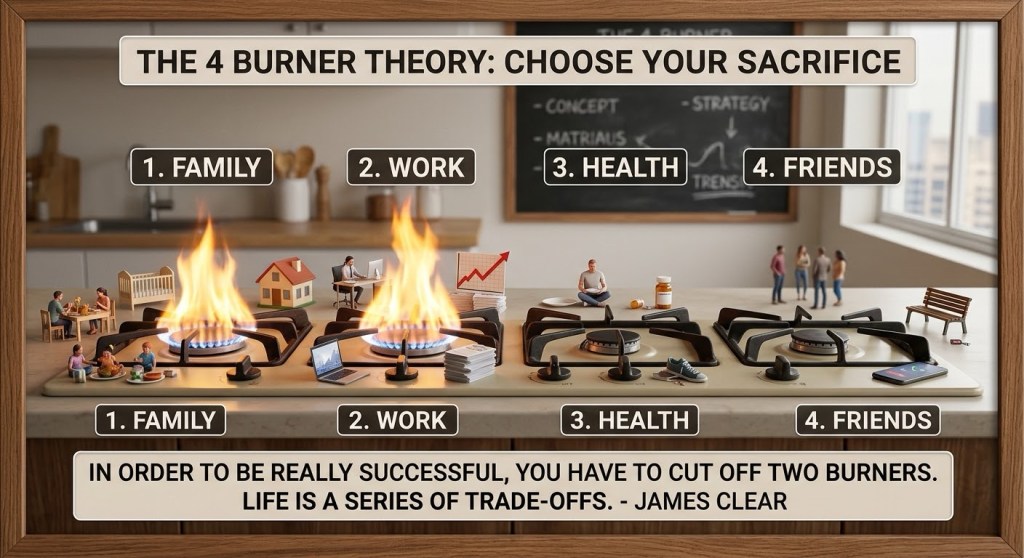
What if the biggest problem with modern life is not that we have too little time, but that we expect too much from the time we have?
We want a successful career, a healthy body, a strong relationship, close friends, time with our families, enough sleep, interesting hobbies and perhaps even a little time to simply do nothing. We are told that with enough discipline, better planning and the right productivity system, we can have it all.
But there is an uncomfortable problem with that idea: our time, energy and attention are limited.
This is where the 4 Burner Theory becomes interesting. The metaphor is simple, but it raises a difficult question that applies not only to our personal lives, but also to leadership: What happens when we try to give everything our full attention at the same time?
Imagine Your Life as a Stove
Imagine a stove with four burners. Each burner represents an important part of your life: family, friends, health and work.
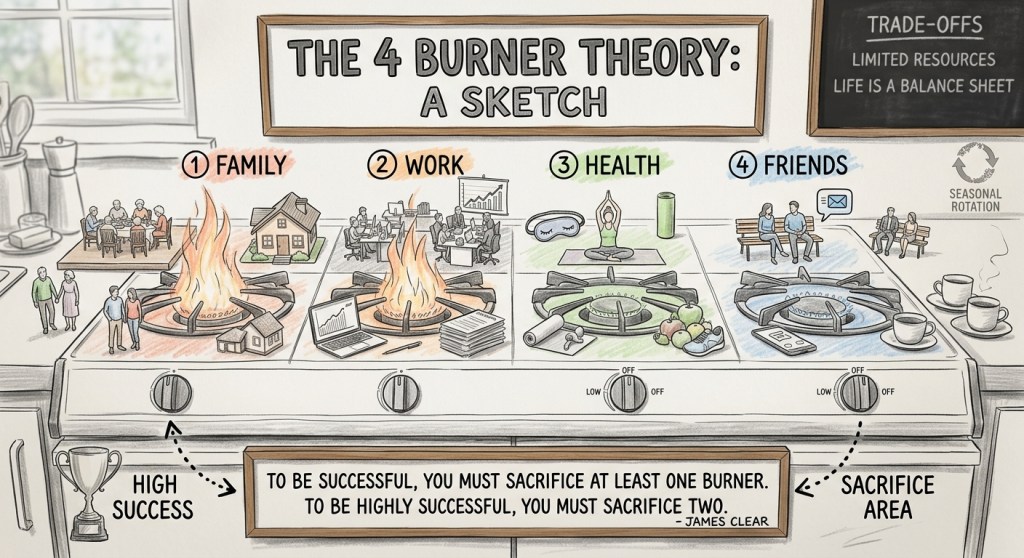
The basic idea of the 4 Burner Theory is that if you want to become extremely successful, you may have to turn down or even switch off some of the burners. The metaphor became widely known through James Clear’s article The Four Burners Theory, which popularized the concept, although the idea itself had already circulated in different forms.
Think about what happens when you turn one burner higher. If you decide to work late every evening because you want to accelerate your career, the work burner gets hotter. But something else has to absorb the cost. Perhaps you see less of your family. Perhaps you stop exercising. Perhaps you have less energy for your friends.
Nothing mysterious happened. You simply moved a limited resource from one area to another.
That is the uncomfortable truth behind the metaphor: you can have many important things in your life, but you cannot give everything maximum attention forever.
The Problem With “Having It All”
The phrase “having it all” sounds inspiring, but it can create an impossible standard.
Modern professionals are encouraged to be ambitious at work, present with their families, maintain friendships, exercise regularly, eat well, sleep eight hours, learn new skills, travel, build a network, stay informed and somehow remain relaxed throughout the process.
The problem is not that any individual goal is unreasonable. The problem is trying to pursue all of them at maximum intensity simultaneously.
This often creates a strange form of imbalance. You may technically be doing everything, but you are rarely fully present anywhere. You answer emails while having dinner. You think about work while exercising. You check your phone while talking to friends. You spend time with your family while mentally preparing for tomorrow’s meeting.
All four burners are on, but none is producing much heat.
The Real Issue Is Not Balance. It Is Trade Offs.
The 4 Burner Theory is really a story about opportunity cost.
In economics, opportunity cost describes what you give up when you choose one option instead of another. If you spend two hours working, those two hours cannot simultaneously be spent exercising. If you spend the evening watching television, you cannot use those same hours to sleep, read, meet a friend or work on a personal project.
This does not mean every decision needs to become a mathematical calculation. It simply means that our choices have consequences.
The problem is that we often make these trade offs without acknowledging them.
We say, “I’ll work this hard just for a few months.” Then the months become years. We say, “I’ll make more time for my friends after this project.” Then another project arrives. We say, “I’ll start exercising when things calm down.” But things rarely calm down by themselves.
The burner that was supposed to be turned down temporarily can quietly become the burner that stays cold.
This Is Where Leadership Enters the Picture
The 4 Burner Theory is particularly useful for understanding leadership because leaders face the same problem on an organizational scale.
A leader has customers to serve, employees to support, budgets to manage, strategies to develop, projects to deliver, risks to control and new opportunities to explore. There are always more things that could receive attention than there is attention available.
This creates one of the most important responsibilities of leadership:
Choosing what deserves attention now.
A leader who tells the organization that everything is a priority has effectively told everyone that there are no priorities.
If every project is strategically important, employees do not know which project matters most. If every meeting is essential, people have less time to do focused work. If every customer request is urgent, the organization becomes reactive.
Good leadership is therefore not simply about deciding what to do.
It is also about deciding what not to do.
The Leader Who Keeps Every Burner on Maximum
Imagine a CEO who wants to be involved in everything. They attend every important meeting, approve every major decision, review presentations, respond to operational problems and want to know what every department is doing.
At first, this may look like dedication.
Eventually, it becomes a bottleneck.
Employees stop making decisions because they know the CEO will eventually intervene. Managers become dependent on approval. The organization cannot move faster than one person can process information.
The CEO may believe they are protecting quality.
In reality, they may be preventing the organization from becoming capable of operating without them.
This is the leadership version of keeping every burner on maximum.
The problem is not that the leader cares too much. The problem is that they have not decided where their attention creates the greatest value.
Attention Is a Leadership Resource
We usually think about money, employees and technology as organizational resources. Attention deserves the same consideration.
Where a leader spends attention sends a powerful signal to everyone else.
If a CEO spends every meeting discussing costs, employees learn that cost control is important. If the CEO constantly asks about innovation, innovation receives attention. If the CEO regularly asks how employees are developing, people understand that learning matters.
This means leaders do not simply set priorities through strategy documents.
They set priorities through their behaviour.
What you ask about repeatedly becomes important. What you measure becomes important. What you praise becomes important. What you ignore can become unimportant, even if you once said it was a priority.
This is why leadership attention is so valuable.
Your team watches where you put the heat.
You Cannot Have Everything at Maximum Intensity
One of the biggest traps for ambitious people is believing that every part of life should be optimized simultaneously.
You should have maximum career performance, maximum fitness, maximum family involvement, maximum productivity, maximum social activity and maximum personal development.
But maximum is not sustainable.
There will be periods when work demands more. There will be periods when family needs more. There will be periods when your health has to take priority. There may even be periods when the most productive thing you can do is recover.
This is not failure.
It is the reality of having limited resources.
The important question is not whether one burner becomes stronger than another.
The important question is whether you chose that imbalance or simply allowed it to happen.
Life Happens in Seasons
Perhaps the most useful way to think about the four burners is through the idea of seasons.
A young entrepreneur may deliberately prioritize work for several years. A new parent may decide that family deserves more attention. Someone preparing for a major sporting event may temporarily make health and training a much larger part of their schedule.
Later, the priorities can change.
The mistake is assuming that the burner settings have to remain fixed forever.
They do not.
Your life changes, your responsibilities change and your values can change. What matters at 25 may not matter in the same way at 45 or 65.
The goal is therefore not permanent balance.
It is intentional prioritization.
But Be Careful What You Turn Off
There is an important limitation to the metaphor.
Turning a burner down is not the same as turning it off forever.
Some parts of life can tolerate periods of reduced attention. Others become increasingly difficult to recover once they have been neglected for too long.
Health is a good example. Relationships are another.
You might have a period when work receives more attention, but if you completely neglect your health for several years, restarting can become much harder. The same applies to friendships and family relationships. People cannot always be placed on pause and expected to remain exactly where you left them.
This is why a better interpretation of the 4 Burner Theory might be:
You do not need every burner at maximum, but you should understand the consequences of letting one go cold.
Sometimes keeping a small flame alive is enough.
The Burnout Connection
This also helps explain why burnout can become such a serious problem.
Working hard is not automatically harmful. There are periods when intense effort is necessary, and many people willingly accept temporary sacrifices to achieve something important.
The danger comes when the temporary becomes permanent.
The World Health Organization describes burnout as an occupational phenomenon resulting from chronic workplace stress that has not been successfully managed. It is associated with exhaustion, mental distance or cynicism toward one’s job and reduced professional efficacy.
The 4 Burner Theory offers a useful metaphor for understanding one possible contributor: when the work burner remains permanently on maximum, the other sources of energy and recovery may receive too little attention.
Sleep decreases. Exercise disappears. Relationships become secondary. Recovery becomes something you will do “later.”
Eventually, the person who is supposed to produce the performance has no capacity left.
This is not sustainable leadership.
What Happens When Leaders Burn Out?
The consequences can extend beyond the individual.
Leaders influence the behaviour of the people around them. If a leader sends emails at midnight, attends meetings while sick, never takes holidays and constantly talks about being busy, employees receive a message even if the leader never explicitly tells them to work the same way.
The culture begins to reward exhaustion.
People may start believing that being constantly available is evidence of commitment.
That is dangerous.
A leader who wants a sustainable organization needs to demonstrate sustainable behaviour.
You cannot tell your team that recovery matters while behaving as if recovery is weakness.
Your team will believe what you do.
AI Makes the Burner Question Even More Important
Artificial intelligence adds another interesting dimension.
AI can help people write faster, analyze information, automate repetitive tasks and complete certain activities in a fraction of the previous time.
That sounds like the perfect solution to the four burner problem.
But there is a catch.
What will you do with the time AI saves?
You could use the additional capacity to produce more work. You could take on more projects, answer more emails and schedule more meetings.
Or you could use some of it to strengthen another burner.
That distinction matters.
Technology does not automatically create balance.
Technology creates capacity. People decide where that capacity goes.
A leader who introduces AI but simply fills the newly available time with more work has not necessarily improved the organization. They may have simply turned the work burner even higher.
The Question Leaders Should Ask
Instead of asking, “How can we do everything?” leaders should ask:
“What deserves our best attention right now?”
That question forces prioritization.
Maybe the answer is a critical customer problem. Maybe it is developing the next generation of leaders. Maybe it is preparing the company for AI. Maybe it is fixing a broken process that is consuming thousands of hours.
The answer will change.
That is normal.
What matters is that the organization knows what matters now.
A leader who can explain what the company is deliberately not focusing on can sometimes create more clarity than a leader who announces another ten priorities.
Your Calendar Reveals Your Real Priorities
There is a simple way to test whether your stated priorities match your real priorities.
Look at your calendar.
Do not look at what you say matters.
Look at where your time actually goes.
If you say health is important but have no time for exercise or recovery, your calendar is telling you something.
If you say family matters but regularly cancel family commitments because of work, your calendar is telling you something.
If you say employee development is a strategic priority but spend every hour in operational meetings, your calendar is telling you something.
Our calendars often reveal our priorities more honestly than our words do.
This is equally true for organizations.
If leadership says innovation is important but employees spend 90 percent of their time dealing with administrative work, innovation is not really receiving the attention leadership claims it deserves.
A Simple Four Burner Audit
Take five minutes and rate your current life from 1 to 10.
Work: How much time and energy are you currently investing in your career or business?
Family: How present are you with the people closest to you?
Friends: Are you maintaining meaningful relationships outside work and immediate family?
Health: How much attention are you giving exercise, nutrition, sleep and recovery?
Now look at the numbers.
The goal is not to make all four equal.
Instead, ask yourself:
Is this the balance I intentionally chose?
If work is a 9 and health is a 3 because you are deliberately going through an intense six month period, that may be a perfectly reasonable decision.
But if work is a 9 and health is a 3 simply because you never stopped to think about it, you may have discovered a problem.
The same exercise works for leadership teams.
Replace the four personal burners with four organizational priorities such as performance, people, innovation and sustainability.
Then ask where the organization’s attention actually goes.
The result can be revealing.
Sometimes the Best Leadership Decision Is to Turn Something Down
Leadership culture often celebrates intensity.
- Work harder.
- Move faster.
- Do more.
- Grow faster.
- Respond immediately.
- Never stop.
But leadership is not a competition to see who can keep the most burners on maximum.
Sometimes the best decision is to turn something down.
Stop a project.
Cancel a meeting.
Delegate a decision.
Reduce unnecessary reporting.
Say no to a customer request that does not fit the strategy.
Give employees uninterrupted time to work.
Protect your own thinking time.
These decisions can feel uncomfortable because they involve saying no.
But every effective priority is also a rejection of something else.
You cannot create focus without creating boundaries.
The Four Burners and the Cost of Saying Yes
Every time you say yes, something else may receive less attention.
- Yes to another project can mean no to strategic thinking.
- Yes to another meeting can mean no to focused work.
- Yes to another business trip can mean less time at home.
- Yes to another evening of work can mean less sleep.
- Yes to another commitment can mean less recovery.
This does not mean you should say no to everything. It means you should understand the price of your yes. That is one of the most useful habits a leader can develop.
Before adding another priority, ask:
What will receive less attention because we are doing this?
If the answer is “nothing,” you may have found a fantasy.
There is almost always a trade off.
The Goal Is Not Perfect Balance
The idea of perfect balance is attractive because it sounds peaceful.
But real life does not work that way.
Some weeks are dominated by work. Some are dominated by family. Some require recovery. Some are full of opportunities that demand extra effort.
Balance may therefore be better understood not as an equal distribution of time, but as the ability to adjust deliberately.
You turn one burner up for a while.
You turn another down.
Then, when the season changes, you adjust again.
The danger is not imbalance.
The danger is unconscious imbalance.
So, Which Burner Should You Turn Down?
There is no universal answer.
That is precisely why the decision belongs to you.
What matters most in your current season? What are you trying to achieve? What are you willing to sacrifice temporarily? What are you absolutely unwilling to sacrifice?
And perhaps most importantly:
What price are you paying for your current priorities?
Because every priority has a price.
If you want extraordinary career growth, something may have to receive less attention.
If you want to spend more time with your family, career growth may become slower.
If you want to train seriously for a sport, social activities may decrease.
If you want to build a company, leisure may temporarily shrink.
None of these choices is automatically right or wrong.
The important thing is to make the choice consciously.
The Leadership Lesson
The 4 Burner Theory ultimately tells us something much bigger than “you cannot have everything.”
It tells us that attention is a scarce resource.
As an individual, you have limited time, energy and attention.
As a leader, your organization has limited time, energy and attention.
Your job is not to keep everything burning equally.
Your job is to decide where the heat matters most.
And that requires courage.
Courage to say no.
Courage to stop something.
Courage to delegate.
Courage to disappoint someone.
Courage to admit that you cannot do everything.
And sometimes, courage to accept that an important goal will take longer because you have decided that another part of your life matters more right now.
That is not a failure of ambition.
It is a sign that you understand the cost of ambition.
The Real Question Is Not “Can I Have It All?”
The better question is:
“What do I want to be fully present for?”
That question changes the conversation.
Because perhaps the goal was never to keep every burner at maximum.
Perhaps the goal is to make sure that the burners you care about are actually producing enough heat.
Your career may not need 100 percent of your energy every day.
Your family may not need 100 percent either.
Your health may not require hours in the gym.
Your friendships may not require constant socializing.
But each one needs some attention if you want it to remain part of your life.
And sometimes, that is enough.
You do not need to give everything everything. You need to give the right things enough.
That may be the most practical lesson of the 4 Burner Theory.
Because success is not simply about how much you can fit into your life.
It is about deciding what deserves a place in it.
A Leadership Exercise for This Week
Before your next leadership meeting, ask your team one simple question:
“If we could focus intensely on only one thing for the next 90 days, what should it be?”
Then ask a second question:
“What would we need to stop doing to make that possible?”
The second question is the important one.
Most organizations are very good at adding priorities.
Far fewer are willing to remove them.
But focus does not come from doing more.
It comes from deciding what deserves the heat.
Research and Further Reading
The 4 Burner Theory itself is a metaphor, not a scientifically established theory. Its strength is that it illustrates several well established concepts from economics, psychology, organizational behaviour and occupational health.
Opportunity Cost is the economic concept that helps explain the trade offs behind the metaphor. Because resources are scarce, choosing one option means giving up another possible use of those resources. OpenStax: Principles of Economics
Attention and Cognitive Limits are important because human cognitive resources are finite. We cannot consciously process unlimited information or give unlimited attention to competing priorities. American Psychological Association: Attention
Burnout and Workplace Stress provide another important connection. The World Health Organization defines burnout as an occupational phenomenon resulting from chronic workplace stress that has not been successfully managed. World Health Organization: Burn-out as an occupational phenomenon
Research into recovery from work has also shown the importance of psychological detachment and recovery experiences for well being and sustainable functioning. Journal of Organizational Behavior: Recovery from work
The Leadership Series Continues
The 4 Burner Theory asks us to think about what deserves our attention.
Our next article asks a different and equally uncomfortable question:
Survivorship Bias: Why Studying Successful People Can Make You Worse at Making Decisions
We love stories about successful people. The entrepreneur who built a billion dollar company. The investor who made a fortune. The athlete who became a champion. The leader who transformed an organization.
But what about everyone who tried the same things and failed?
What can we learn from the people we never hear about?
That is where Survivorship Bias begins.







Leave a comment