
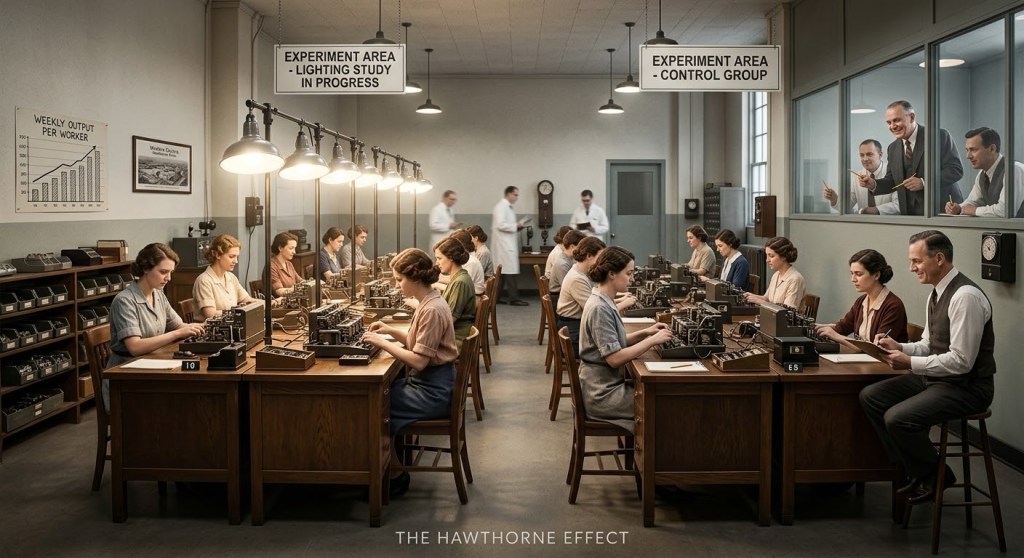
What happens when people know someone is watching them?
Do they work harder because their working conditions have improved? Do they become more engaged because management suddenly seems interested in them? Or do they simply change their behaviour because they know they are being observed?
This question has fascinated researchers, psychologists and managers for almost a century. It also contains an important lesson for modern leadership: people do not only respond to what leaders change. They also respond to the attention leaders give them.
That idea is commonly associated with the Hawthorne Effect.
But there is a fascinating twist.
The story we have been telling about the Hawthorne Effect for decades is much more complicated than the popular version suggests.
And understanding that difference can make you a better leader.
What Is the Hawthorne Effect?
The Hawthorne Effect is commonly described as the tendency for people to change their behaviour when they know they are being observed or studied.
The concept became associated with a series of workplace experiments conducted at the Western Electric Hawthorne Works near Chicago during the 1920s and 1930s.
Researchers were interested in understanding what influenced worker productivity. They experimented with different aspects of the working environment, including lighting, rest periods and working hours.
The results appeared surprising.
Productivity sometimes increased when conditions were changed. But productivity could also increase when conditions were changed back.
This created an intriguing possibility: perhaps the workers were responding not only to the physical changes but also to the fact that they were receiving attention and were aware that they were part of a study.
The popular interpretation became simple:
When people know they are being watched, they change their behaviour.
That explanation became one of the most famous ideas in management.
But the actual history is more complicated.
The Hawthorne Story Is Not as Simple as You Think
The original Hawthorne studies have been debated extensively by historians, economists and researchers.
Later analyses have questioned whether the experiments actually demonstrated a simple “people work harder when they are observed” effect. The studies involved multiple experiments, changing conditions and methodological limitations, making it difficult to isolate one single cause for the productivity changes.
So it would be inaccurate to present the Hawthorne Effect as a simple scientific law.
There is, however, a broader and very useful leadership lesson behind the concept:
Being observed, receiving attention and knowing that someone cares about your work can influence behaviour.
And that idea remains highly relevant.
Especially today.
Why Attention Matters at Work
Think about the last time someone important at work took a genuine interest in what you were doing.
Perhaps your manager asked how a project was going.
Perhaps a senior leader remembered something you had mentioned weeks earlier.
Perhaps someone asked for your opinion before making a decision.
Maybe a leader noticed that you had solved a difficult problem and specifically thanked you for it.
Did that change how you felt?
Probably.
You may have felt that your work mattered. You may have become more motivated to contribute. You may have felt more connected to the organization.
Nothing about your job description necessarily changed.
Your salary did not change.
Your office did not change.
Your computer did not change.
But something important changed:
Someone was paying attention.
People Notice What Leaders Notice
One of the most powerful things a leader can do is pay attention to the right things.
Imagine a manager who regularly asks about deadlines but never asks about quality.
The team quickly learns that deadlines matter.
Now imagine a manager who constantly asks how many tasks were completed but never asks whether the team is overwhelmed.
The team learns that output matters more than sustainability.
Imagine another leader who asks employees:
“What did you learn from this?”
“What is slowing you down?”
“What do you think we should change?”
“What do you need from me?”
The team receives a different message.
The questions themselves become signals.
Leadership attention tells people what the organization considers important.
Your Questions Become Culture
This is one of the most underestimated aspects of leadership.
Leaders often believe culture is created through values statements, workshops and corporate presentations.
But culture is also created through repeated questions.
If you always ask:
“Is it finished?”
You create a culture of completion.
If you ask:
“Is it good enough?”
You create a culture of quality.
If you ask:
“What did we learn?”
You create a culture of learning.
If you ask:
“Who is responsible?”
You may create accountability.
If you ask:
“How can I help?”
You create a different relationship between leadership and the team.
The questions you repeat become part of the organization’s operating system.
Attention Is Not the Same as Micromanagement
There is an important distinction here.
Good leadership attention is not the same as constant surveillance.
A leader who checks every email, monitors every minute and asks for updates several times a day is not necessarily showing useful attention.
They may simply be creating pressure.
The difference is intent and autonomy.
Good attention communicates:
“I care about the outcome, I am interested in your perspective and I am available if you need support.”
Micromanagement communicates:
“I do not trust you to do this without me watching.”
Those two experiences can produce completely different behaviours.
One builds engagement.
The other can build anxiety and dependence.
The Remote Work Problem
The Hawthorne Effect becomes particularly interesting in the age of remote and hybrid work.
When people worked in the same office, leaders could see their teams.
They saw people arriving.
They saw people talking.
They saw who looked busy.
They saw who stayed late.
They could walk over to someone’s desk and ask a question.
Remote work removes many of these visual signals.
A manager may suddenly feel that they have less control.
This can lead to a dangerous reaction:
More monitoring.
More meetings.
More status updates.
More messages.
More tracking software.
More requests for progress reports.
But visibility is not the same as productivity.
A person sitting in front of a computer for eight hours is not necessarily producing more value than someone who completes excellent work in four focused hours.
Remote leadership therefore requires a shift from watching activity to managing outcomes.
The Danger of “Productivity Theatre”
When people believe they are being monitored, they may optimize for what is visible rather than what is valuable.
Employees may respond quickly to every message because responsiveness is visible.
They may attend unnecessary meetings because attendance is visible.
They may stay online longer because online status is visible.
They may send frequent updates because activity is visible.
Meanwhile, deep work becomes harder.
This creates what could be called productivity theatre: behaviour that looks productive to an observer without necessarily creating meaningful results.
A leader who measures visible activity can accidentally teach employees to perform productivity rather than create value.
The better question is:
What outcome are we actually trying to achieve?
Attention Can Increase Engagement
There is another side to the story.
Attention can be incredibly motivating when it is meaningful.
Employees generally want to know that their contribution matters.
A leader who notices good work can reinforce the behaviours they want to see repeated.
But effective recognition is specific.
Instead of saying:
“Great job.”
Try:
“The way you simplified that process saved the team several hours this week.”
The second statement tells the employee exactly what was valuable.
It also tells everyone else what the organization appreciates.
Recognition therefore does more than make someone feel good.
It can communicate standards.
The Leader Who Only Notices Problems
Consider two managers.
The first only becomes involved when something goes wrong. If a project is late, they appear. If a customer complains, they appear. If someone makes a mistake, they appear.
When things go well, silence.
The second manager notices both problems and progress. They ask about obstacles, but they also recognize improvements. They pay attention to good decisions, not just bad ones.
Over time, the teams will experience these managers very differently.
The first teaches people that leadership attention is associated with trouble.
The second teaches people that leadership attention can be useful.
That distinction matters.
If employees only hear from their manager when something goes wrong, they may eventually avoid bringing problems forward.
And that creates another leadership problem.
What Happens When People Are Afraid to Be Seen?
The Hawthorne Effect is often discussed as if observation is automatically positive.
It isn’t.
Being watched can motivate people.
It can also make them anxious.
The difference often depends on the environment.
If employees believe observation is designed to help them, learning can increase.
If they believe observation is designed to punish them, defensive behaviour can increase.
This is why psychological safety matters.
A team that knows mistakes can be discussed openly is more likely to surface problems early.
A team that believes every mistake will be used against them may hide problems.
The leader’s attention then becomes a source of either learning or fear.
Leadership Across Generations
This becomes even more interesting in today’s multigenerational workplace.
Baby Boomers, Generation X, Millennials and Generation Z may have different expectations about communication, autonomy, feedback and management.
But it would be a mistake to reduce entire generations to stereotypes.
Individual preferences vary enormously.
Still, leaders are dealing with employees who entered the workplace under very different technological and cultural conditions.
Some may prefer independence and minimal intervention.
Others may expect more frequent feedback.
Some may value face to face interaction.
Others may be perfectly comfortable communicating asynchronously.
The leadership challenge is therefore not to find one universal level of attention.
It is to understand what kind of attention helps each person perform at their best.
Good leadership is not treating everyone identically. It is creating clarity while understanding individual needs.
The AI Workplace Changes the Equation Again
Artificial intelligence introduces another layer.
AI can monitor performance, analyze workflows, summarize meetings and generate reports.
Organizations may soon have more information about employee activity than ever before.
But having more data does not mean having better leadership.
A system can tell you how many messages someone sent.
It may not tell you whether those messages were useful.
It can tell you how long someone was online.
It may not tell you how deeply they were thinking.
It can count meetings.
It cannot automatically determine whether those meetings created value.
This creates a major leadership question:
Just because you can measure something, should you?
Technology can make observation easier.
It does not necessarily make observation wiser.
The Attention Economy Inside Your Company
Your employees already compete for attention.
Emails.
Slack messages.
Teams notifications.
Meetings.
Dashboards.
AI assistants.
Customer requests.
Internal requests.
Leadership announcements.
In this environment, the leader’s attention becomes even more valuable.
When a CEO suddenly focuses on a particular issue, the organization notices.
When leadership asks about AI every week, AI becomes a priority.
When leadership asks about employee development every quarter, development becomes more visible.
When leadership repeatedly asks about costs, employees start looking for savings.
This is why leaders need to be extremely deliberate about where they put their attention.
Whatever leadership consistently looks at becomes more important.
But Attention Has a Dark Side
There is a temptation for leaders to think:
“If I pay more attention, performance will improve.”
Not necessarily.
Too much attention can become pressure.
Imagine an employee working on a complex project. Their manager asks for an update every morning.
The employee starts thinking about the manager’s next update rather than the actual problem.
The manager believes they are helping.
The employee experiences interruption.
The intention is good.
The result is poor.
This is why effective leadership requires calibrated attention.
Sometimes people need more guidance.
Sometimes they need recognition.
Sometimes they need feedback.
And sometimes they simply need to be left alone to do excellent work.
Knowing which one is required is part of leadership.
The Difference Between Visibility and Trust
A strong leader does not need to see everything.
They need to know what matters.
This is especially important with knowledge workers.
If you hire someone because you believe they are capable, then constantly monitor every action, you create a contradiction.
You are saying:
“I trust your expertise.”
While behaving as if:
“I need to verify everything you do.”
Trust does not mean abandoning accountability.
It means defining clear expectations and then giving capable people enough autonomy to meet them.
The goal is not zero oversight.
The goal is appropriate oversight.
What Should Leaders Pay Attention To?
A useful approach is to focus attention on four areas.
Outcomes: Are we achieving what we said we would achieve?
Obstacles: What is preventing people from doing their best work?
Development: Are our people becoming more capable over time?
Culture: Are our behaviours creating the kind of organization we actually want?
These questions are more valuable than simply asking:
“Are people busy?”
Busy is easy to observe.
Impact is harder.
And leadership is ultimately about impact.
The Hawthorne Effect and Recognition
There is another lesson worth remembering.
Sometimes people do better work simply because someone finally notices them.
Not because they are being manipulated.
Because recognition satisfies something fundamental: the desire to know that our contribution matters.
A leader who says:
“I noticed what you did.”
can have more impact than a leader who sends another motivational email.
But recognition should not become artificial.
People quickly notice when praise is generic, forced or political.
The most effective recognition is specific, timely and connected to real contribution.
“Thank you” is nice.
“I noticed that you helped the new team member understand the process instead of simply doing the work for them. That is exactly the kind of leadership behaviour we want here.”
That teaches something.
Attention Creates Signals
This may be the deepest leadership lesson of the entire concept.
Leaders are constantly sending signals.
Not only through speeches.
Through calendars.
Through questions.
Through meetings.
Through what they measure.
Through what they praise.
Through what they ignore.
Through who they listen to.
Through who receives their time.
Employees interpret these signals constantly.
If you say collaboration matters but reward individual performance, employees notice.
If you say innovation matters but punish every failed experiment, employees notice.
If you say people are your greatest asset but never ask how they are doing, employees notice.
If you say trust matters but monitor every activity, employees notice.
People listen to what leaders say. They believe what leaders consistently do.
A Simple Leadership Experiment
Try this with your team this week.
Choose three employees whose work you do not normally discuss in detail.
Have a short conversation with each one.
Do not ask for a status report.
Instead, ask:
“What is working well?”
“What is getting in your way?”
“What is one thing you think we could improve?”
Then listen.
Do not immediately defend the company.
Do not explain why something cannot change.
Do not turn the conversation into another performance review.
Just listen.
You may discover that a small amount of genuine attention produces more useful information than another hour of reporting.
And you may discover something else.
People often know exactly what needs to improve.
They simply need someone with enough authority to ask.
The Leader’s Attention Is a Limited Resource
There is a connection here with the 4 Burner Theory from our previous article.
A leader cannot give unlimited attention to everything.
Your calendar is finite.
Your cognitive capacity is finite.
Your team’s attention is finite.
This means leadership requires prioritization.
If you spend all your time monitoring small operational details, you may have no attention left for strategy.
If you spend every day solving individual problems, you may never fix the systems creating those problems.
If you attend every meeting, you may have no time to think.
The question is therefore not:
“How can I pay attention to everything?”
It is:
“Where does my attention create the greatest value?”
The Real Hawthorne Effect for Modern Leaders
Whether every productivity change in the original Hawthorne experiments can be explained by a simple observation effect is still a matter of scientific debate.
But the broader lesson remains powerful.
People notice when leaders pay attention.
They notice what leaders ask about.
They notice what leaders reward.
They notice what leaders measure.
They notice whether attention feels like support or surveillance.
And they adjust their behaviour accordingly.
This is why leadership attention should never be treated as a trivial resource.
Where you look, your organization looks.
Where you consistently pay attention, your team learns to pay attention too.
The Leadership Lesson
A great leader does not simply tell people what matters.
They show people what matters through their attention.
If you want quality, look at quality.
If you want learning, ask what people learned.
If you want innovation, make it safe to experiment.
If you want accountability, own your own mistakes.
If you want trust, stop measuring meaningless activity.
If you want engaged employees, take an interest in their work.
And if you want people to speak honestly, make sure your attention does not become something they fear.
The Hawthorne Effect, in its simplest form, asks what happens when people know they are being observed.
Leadership asks a deeper question:
What happens when people know they are being seen?
There is a difference.
Being watched can create pressure.
Being seen can create connection.
And the best leaders understand the difference.
The Question to Take With You
Look at your own calendar from the last two weeks.
Where did your attention go?
How much time did you spend discussing problems?
How much did you spend developing people?
How often did you ask for updates?
How often did you ask for ideas?
How often did you recognize good work?
And perhaps the most important question:
What has your team learned is important because of what you consistently pay attention to?
Your answer may tell you more about your leadership culture than your company’s values statement ever could.
Because leadership is not only about what you tell people to focus on. It is about what you consistently focus on yourself.
Research and Further Reading
The Hawthorne Effect is more complicated than the popular management story suggests. The original research at the Hawthorne Works involved several different experiments, and later scholars have questioned whether the results can be attributed to a single observation effect. That nuance is important: the term remains useful, but it should not be treated as a simple scientific law stating that “people always work harder when watched.”
The original Hawthorne research was associated with the Hawthorne Works of Western Electric and researchers including Elton Mayo, Fritz Roethlisberger and others. The research contributed significantly to the development of the human relations movement in management. Encyclopaedia Britannica: Hawthorne Research
A detailed historical examination by Steven Levitt and John List revisited the famous Hawthorne experiments and argued that the conventional interpretation of the original studies may have been overstated. Their work is particularly useful for understanding why the popular version of the Hawthorne Effect should be treated carefully. University of Chicago: Was There Really a Hawthorne Effect at the Hawthorne Plant?
Research into employee recognition and motivation provides a broader modern connection. Recognition and appreciation can influence employee engagement and workplace experiences, although the effects depend on how recognition is delivered and the context in which it occurs. American Psychological Association: Employee Recognition and Workplace Well Being
Research on psychological safety, particularly the work of Amy Edmondson, is also highly relevant. Teams are more capable of learning and discussing problems when people feel safe to speak up, ask questions and acknowledge mistakes without fear of interpersonal punishment. Harvard Business School: Psychological Safety and Learning Behavior in Work Teams
The Leadership Series Continues
So far, we have looked at several different ways of thinking about leadership.
The Red Car Theory showed us how attention changes what we notice.
The 4 Burner Theory showed us that priorities require trade offs.
Survivorship Bias showed us why studying only successful people can lead us to the wrong conclusions.
And The Hawthorne Effect shows us how powerful attention can become once people know they are being seen.
But our next topic takes leadership into a completely different direction.
Glue Players: The People Holding Your Organization Together
Every organization has them.
They are not always the loudest people in the room. They may not have the biggest title. They may not even appear on the organizational chart as particularly important.
But when they leave, everything suddenly becomes harder.
They connect people.
They solve problems nobody officially owns.
They know how things really work.
They help new employees.
They remember the details.
They quietly prevent small problems from becoming big ones.
They are the Glue Players.
And many organizations do not realize how valuable they are until they are gone.
Next Monday, we explore why every organization needs Glue Players and why great leaders need to know who they are.






Leave a Reply