
Have you ever finished an entire chapter, closed the book, and wondered where all the information went?
You spent the time. You read every page. You even highlighted the important parts. Yet only a few days later, most of it has disappeared. This is one of the biggest frustrations for students, professionals, and anyone trying to learn something new.
The good news is that the problem is usually not your memory. It is your learning strategy.
Reading alone is rarely enough. Your brain remembers information much better when you actively work with it before, during, and after reading. That is exactly what the PQ4R Method was designed to do. Instead of turning pages and hoping something sticks, you guide your brain through a structured process that improves understanding, strengthens memory, and makes learning far more effective.
What is the PQ4R Method?
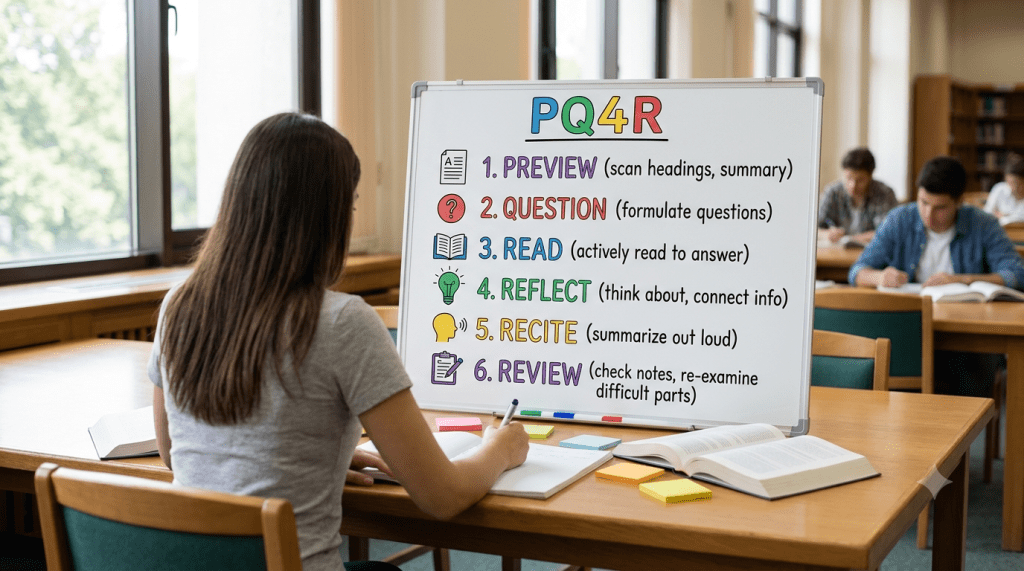
PQ4R stands for Preview, Question, Read, Reflect, Recite, and Review. Each step has a clear purpose, and together they create a learning process that follows the way our brain naturally builds long term memories.
Unlike simply reading a chapter from beginning to end, the PQ4R Method encourages you to prepare your mind before learning and actively work with the information afterwards.
Although it was originally developed for students, it is equally useful for learning at work, reading business books, completing online courses, or developing new personal skills.
Step One: Preview
Before you begin reading, spend a few minutes looking through the material.
Read the chapter title, headings, diagrams, summaries, and any highlighted words. Do not worry about understanding every detail yet. The goal is simply to create a mental map of what you are about to learn.
Think of it as looking at a map before starting a journey. You may not know every road yet, but you already have a sense of direction.
Step Two: Question
Now turn the headings into questions.
If a chapter is called “The Science of Memory,” ask yourself, “How does memory actually work?” or “Why do we forget things?”
Questions give your brain a clear purpose. Instead of reading passively, you begin searching for answers. This increases attention and keeps your mind engaged throughout the reading process.
Curiosity is one of the strongest drivers of learning.
Step Three: Read
Now read carefully, but with a goal.
Instead of trying to memorize every sentence, focus on answering the questions you created. Look for the main ideas, examples, and connections between concepts.
Many people believe they need to remember every detail immediately. In reality, understanding the overall concept first makes remembering the details much easier later.
Step Four: Reflect
Reflection is where learning becomes personal.
After reading a section, stop and think about what you have learned. How does it connect with something you already know? Have you experienced something similar? Can you apply this idea in your own work or daily life?
The more personal the connection becomes, the easier it is for your brain to remember the information.
Knowledge without reflection often disappears quickly. Knowledge connected to experience tends to stay.
Step Five: Recite
Close the book.
Now explain the topic in your own words without looking at your notes.
This step feels challenging because your brain has to retrieve the information instead of simply recognizing it. That effort is exactly what strengthens memory.
If you struggle to explain something clearly, you have found an area that needs another review.
Many people skip this step because it feels difficult. Ironically, it is one of the most powerful parts of the entire method.
Step Six: Review
Learning does not end when you finish reading.
Come back to the material after a day, a few days later, and again after a week. Review your notes, answer your questions again, and check whether you can still explain the concepts.
This repeated review interrupts the natural forgetting process and moves information into long term memory.
Even short review sessions are often more effective than spending several hours rereading everything from the beginning.
Why does the PQ4R Method work?
The PQ4R Method combines several learning principles that cognitive science has supported for decades.
Previewing prepares your brain for new information. Asking questions increases curiosity and focus. Reading provides the knowledge. Reflection creates meaningful connections. Reciting strengthens memory through active recall. Reviewing protects against forgetting.
Instead of depending on one learning technique, the method combines several of the most effective strategies into one simple routine.
That is why it works so well for complex subjects that require real understanding rather than simple memorization.
How it helps in professional life
Learning has become part of almost every career. New technologies, software, regulations, and processes appear constantly.
The PQ4R Method helps you understand reports more quickly, remember training sessions longer, and learn new skills with less frustration.
Imagine reading a company handbook or attending an online certification course. Instead of simply finishing the material, you ask questions before you begin, summarize the key ideas afterwards, and review them over the following days.
The result is greater confidence and less time spent relearning information you thought you already knew.
For people working from home, where self directed learning has become increasingly important, this method provides structure and keeps learning focused.
How it helps students
Students often spend hours highlighting textbooks without actively thinking about the material.
The PQ4R Method changes that completely.
Each chapter becomes an active investigation rather than a passive reading exercise. Students ask questions, explain concepts, and regularly test their own understanding.
This not only improves exam preparation but also builds deeper knowledge that remains useful long after the test is over.
Many students find they spend fewer hours studying while achieving better results because they are learning more effectively instead of simply reading longer.
How it helps in everyday life
Learning is not limited to classrooms or offices.
Whether you want to improve your financial knowledge, learn photography, understand nutrition, master a new language, or develop another hobby, the PQ4R Method gives every learning session a clear structure.
Instead of finishing a book and forgetting most of it, you begin building knowledge that becomes part of your everyday life.
Over time, this creates confidence because you know you are not just collecting information. You are actually learning.
Using AI without losing the learning process
Artificial Intelligence is an excellent learning assistant, but it should never replace your own thinking.
AI can help you create questions before reading, explain difficult topics, summarize long chapters, generate quizzes, or identify gaps in your understanding.
The important part is knowing when to use it.
First, think for yourself. Read the material. Explain it in your own words. Then ask AI to challenge your understanding or help you improve it.
When AI becomes your learning partner instead of your shortcut, it can dramatically increase both speed and understanding.
Small Changes Create Better Learning
The PQ4R Method is not about studying longer.
It is about studying with intention.
By preparing your mind before reading, asking meaningful questions, connecting new knowledge with your own experience, testing your understanding, and reviewing information over time, you give your brain exactly what it needs to build lasting memories.
The next time you open a book, begin an online course, or start learning a new skill, resist the temptation to simply read from the first page to the last.
Take a few minutes to guide your learning instead.
You may discover that learning becomes easier, faster, and much more enjoyable when your brain becomes an active partner in the process rather than just a place where information briefly passes through.








Leave a comment