
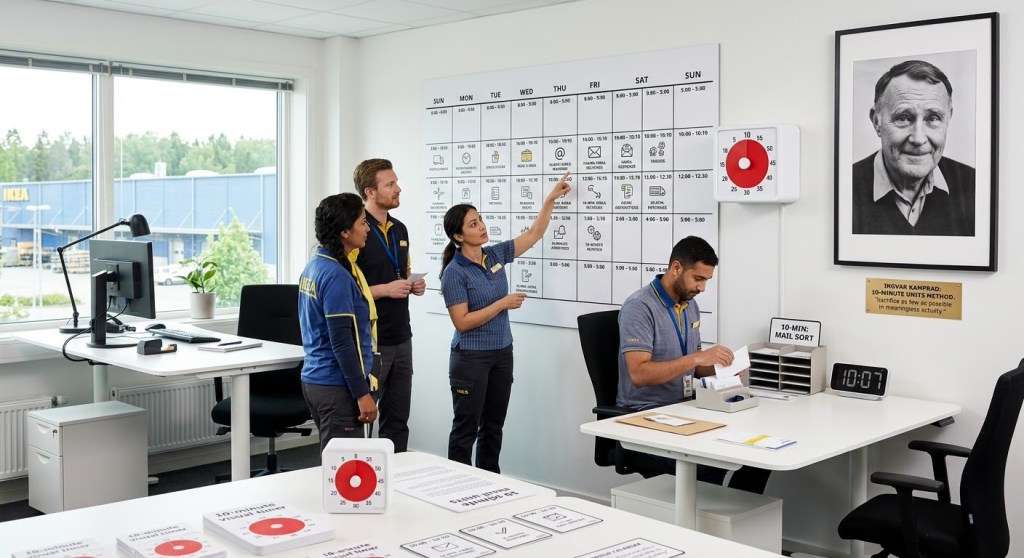
Ten minutes does not sound like much.
You can make coffee. Scroll through your phone. Check a few emails. Watch half a YouTube video. Wait for someone who is running late.
Or you can change the direction of your day.
That was the idea behind one of the simplest productivity philosophies associated with IKEA founder Ingvar Kamprad.
Kamprad believed that time was our most valuable resource. In The Testament of a Furniture Dealer, he argued that ten minutes can be surprisingly valuable because once they are gone, they can never be recovered. His advice was to divide life into ten minute units and sacrifice as few of them as possible to meaningless activity. (The Guardian)
It sounds almost ridiculously simple.
But there is a powerful question hidden inside it:
What if you stopped thinking about productivity in hours and started thinking about it in ten minute units?
You might discover that you have far more usable time than you thought.
The Ten Minutes We Keep Losing
Most people do not lose their time in dramatic ways.
- They lose it in fragments.
- Seven minutes checking email.
- Three minutes scrolling.
- Five minutes waiting for a meeting to start.
- Ten minutes talking about something that could have been decided in two.
- Eight minutes switching between tasks.
- Another five minutes trying to remember what they were doing before the interruption.
None of these moments feels important enough to worry about.
But add them together. Five minutes here. Ten minutes there. Another seven minutes later. By the end of a day, the missing time can become significant. This is what makes Kamprad’s idea so powerful.
He was not necessarily saying that every ten minute period must be filled with work.
He was making a broader argument:
Be conscious of what you are doing with your time.
Ten minutes spent deliberately resting is not necessarily wasted. Ten minutes spent mindlessly moving between apps might be.
The difference is intentionality.
Kamprad’s Original Idea Was Bigger Than a Productivity Hack
It is tempting to turn Kamprad’s philosophy into another productivity trick:
“Set a timer for ten minutes and work.”
But that misses the deeper point.
Kamprad was making a statement about the value of time itself.
In the text associated with IKEA’s Testament of a Furniture Dealer, he wrote that ten minutes are not merely a fraction of an hour or a unit of paid labour. They are a piece of your life. (Scribd)
That changes the question.
Instead of asking:
“How much money is ten minutes worth?”
you ask:
“What is this ten minutes of my life worth?”
That is a much more uncomfortable question.
Because once you start thinking that way, you notice how often you give your time away without making a conscious decision to do so.
Why Ten Minutes Can Be Psychologically Powerful
There is a problem with large tasks.
They feel large.
- “Write the report.”
- “Clean the entire office.”
- “Study for the exam.”
- “Create the business plan.”
- “Organize the finances.”
- “Write the book.”
The brain sees the size of the task and immediately calculates the effort. And sometimes the result is avoidance. You open your email instead. This is where the ten minute principle becomes useful.
- You do not have to finish the report.
- You only have to work on it for ten minutes.
- You do not have to write the book.
- You only have to spend ten minutes on the next section.
- You do not have to clean the entire office.
- You can organize one drawer.
The objective changes from:
Finish the task.
to:
Start the task.
And starting is often the difficult part.
The Science of the “Fresh Start”
Modern psychology gives us an interesting explanation for why changing the way we frame time can affect motivation.
Researchers Hengchen Dai, Katherine Milkman and Jason Riis identified what they called the Fresh Start Effect.
Across three archival field studies, they found that people were more likely to engage in aspirational behaviours after temporal landmarks such as the beginning of a week, month, year, semester, birthday or holiday. Gym visits, searches for “diet” and commitments to pursue goals all increased around these landmarks. (pubsonline.informs.org)
Why?
Temporal landmarks create psychological boundaries. They divide time into chapters.
- Before.
- After.
- Old period.
- New period.
This is important for the Kamprad principle because a ten minute unit can create a much smaller version of the same psychological boundary.
Instead of thinking:
“I need to work on this all afternoon.”
you create a tiny chapter:
“For the next ten minutes, this is what I do.”
The boundary makes the task psychologically smaller.
Ten Minutes Can Defeat the “I Don’t Have Time” Excuse
There is a phrase we hear constantly:
“I don’t have time.”
Sometimes that is absolutely true.
But sometimes what we really mean is:
“I don’t have enough uninterrupted time.”
There is a difference. You might not have two free hours to work on a presentation. But do you have ten minutes? You might not have an entire afternoon to learn something new. But do you have ten minutes? You might not have an hour to organize your desk. But do you have ten minutes?
The answer is surprisingly often yes. This does not mean ten minutes is always enough.
It means ten minutes can be enough to begin.
And beginning creates momentum.
The 10 Minute Rule for Difficult Tasks
Here is where the Kamprad principle becomes particularly useful.
Take a task you have been avoiding. Do not promise yourself that you will finish it.
Promise yourself only this:
I will work on it for ten minutes.
Set a timer. Remove distractions. Start.
When the ten minutes end, you have two choices. Stop or continue. Both are valid.
If you stop, you have still made progress. If you continue, you have overcome the initial resistance that prevented you from starting. The psychological trick is that you are not negotiating with your brain about the entire task.
You are negotiating about ten minutes.
Ten minutes feels manageable.
Three hours does not.
But Don’t Confuse Ten Minutes With a Magic Number
This is where we need to be careful.
There is no strong scientific evidence showing that exactly ten minutes is the optimal universal work interval.
Ten minutes is Kamprad’s practical unit, not a scientifically established magic number.
And that distinction matters.
Research on microbreaks, for example, often defines a microbreak as a short interruption of no more than ten minutes, but the evidence does not establish ten minutes as the perfect duration for everyone or every task. A 2022 systematic review and meta-analysis found that microbreaks reliably benefit well-being, while performance effects depend on the type and cognitive demands of the task. The researchers also found that longer breaks tended to produce larger performance benefits. (PLOS)
So Kamprad’s ten minutes should not be treated as a law of human cognition.
Think of it as a unit of attention.
A deliberately chosen small block.
Ten Minutes of Work Is Different From Ten Minutes of Break
This distinction is important.
The Kamprad principle is fundamentally about the value of time.
It does not mean:
“Every ten minutes must be productive.” That would turn productivity into another form of pressure. Sometimes ten minutes of doing nothing is exactly what you need. Sometimes ten minutes of walking can restore your attention.
Sometimes ten minutes talking to someone you care about is more valuable than ten minutes answering emails.
Research on workplace microbreaks supports part of this idea. A systematic review and meta-analysis found that short breaks can benefit worker well-being and, in some circumstances, performance. (PLOS)
Another study published in the Journal of Applied Psychology examined daily microbreaks and found that their relationship with job performance was mediated by positive affect, with effects varying according to work engagement. (PubMed)
So the goal is not to eliminate empty space.
The goal is to make empty space intentional.
The Ten Minute Audit
If you want to understand how much time you actually lose, try something unusual for one day.
Do not track your entire day in hours. Track it in ten minute units. There are 144 ten minute units in 24 hours. You obviously cannot control all of them. Sleep, meals, commuting, family, recovery and unexpected events all matter.
Instead, focus on your waking discretionary time.
For every ten minute unit, ask:
What am I doing?
Then classify it:
- Create
- Maintain
- Connect
- Recover
- Learn
- Waste
The last category is not about judging yourself. It is about noticing. You might discover that your biggest problem is not that you lack time. It is that your time disappears without a decision.
The Meeting That Costs More Than It Looks
Consider a 60 minute meeting.
At first glance, it costs one hour. But the real cost may be much higher. Ten minutes preparing. Five minutes waiting for everyone to join. Sixty minutes in the meeting. Ten minutes afterwards to recover and return to the previous task.
Now the meeting has consumed 85 minutes. This is where the Kamprad principle becomes useful for organizations.
Ask:
How many ten minute units does this meeting really consume?
Maybe the answer is nine.
Maybe it is twelve.
Maybe it is one hundred and twenty ten minute units across an entire team.
Suddenly a “one hour meeting” looks very different.
This is one reason Kamprad’s philosophy can be applied beyond personal productivity.
Time has an organizational cost.
The Hidden Cost of Switching
There is another reason those small fragments matter.
When you move from one task to another, you do not necessarily transfer your attention instantly.
You have to reconstruct context.
- What was I doing?
- Where was I?
- What was I about to write?
- What decision had I made?
- What information was I looking for?
This is one reason a day filled with tiny interruptions can feel exhausting even when the individual interruptions seem harmless.
The problem is not always the ten minutes themselves. It is the fragmentation they create. A ten minute block of uninterrupted work can therefore be more valuable than ten scattered minutes.
This is the key distinction:
Ten minutes is not the same as ten minutes.
Ten focused minutes can create progress.
Ten fragmented minutes can create almost nothing.
The Kamprad Method Is Really About Friction
Imagine two tasks.
Task A:
“Reply to one simple email.”
Task B:
“Develop a new business strategy.”
Your brain reacts differently.
Task A has low psychological friction.
Task B has high psychological friction.
This is where ten minutes can help.
Instead of asking yourself to complete Task B, define the first ten minute action:
Open the document. Write the objective. List three problems. Write the first paragraph. Find the three most important numbers. Create the first slide. Once the first action is defined, the task becomes concrete. And concrete tasks are easier to start than abstract ones.
This is why a practical version of the Kamprad method could be summarized as:
Shrink the task until starting feels easy.
What If You Only Have Ten Minutes?
This is perhaps the most useful question.
You have ten minutes before your next meeting.
What do you do?
Most people think:
“There’s no point starting anything.” That is exactly where the method challenges conventional thinking. Ten minutes could be enough to:
- answer one important email
- write 150 words
- review one page
- prepare three talking points
- organize a folder
- make tomorrow’s priority list
- read a research abstract
- practice a language
- stretch
- walk
- clear your desk
- make one important decision
None of these activities will transform your life in ten minutes.
But repeated every day, they accumulate.
And accumulation is where small units become powerful.
The Mathematics of Small Time
Consider someone who deliberately recovers just three ten minute units every working day.
That is 30 minutes per day.
Across five working days:
150 minutes.
Across roughly 48 working weeks:
7,200 minutes.
That is:
120 hours.
Three recovered ten minute units a day can therefore theoretically create the equivalent of 15 additional eight hour working days over a year.
Of course, this does not mean those 120 hours should all become work.
That would completely miss Kamprad’s point.
You could use those hours to learn.
Exercise.
Read.
Think.
Create.
Spend time with people.
Rest.
Or simply leave them unplanned.
The value lies in having the choice.
The Dark Side of the 10 Minute Method
Every productivity philosophy has a potential failure mode.
The Kamprad principle can become dangerous if interpreted as:
“Every minute I am not productive is wasted.”
That is not productivity.
That is optimization without a purpose.
Human beings need rest.
We need relationships.
We need play.
We need boredom.
We need time without measurable output.
If you start measuring every ten minute block and judging yourself for every one that does not produce something, you have transformed a philosophy about respecting time into a philosophy about maximizing work.
That is not the same thing.
The real question is not:
“Did these ten minutes produce something?”
It is:
“Did I choose how to spend these ten minutes?”
The Future Self Problem
There is another fascinating piece of research that makes the Kamprad principle even more relevant.
Psychologists have found that temporal landmarks can have an unexpected downside.
A 2020 study by Koo, Dai, Mai and Song found across five studies that when people anticipate an upcoming temporal landmark, such as a new month or another meaningful boundary, they may actually reduce their current effort because they psychologically separate their present self from their future self.
In other words:
“Future me will deal with it.”
The researchers call this a kind of “intrapersonal loafing.” People become optimistic that their future self will take responsibility for the unfinished goal. (ScienceDirect)
This is exactly the opposite of Kamprad’s philosophy.
Kamprad says:
Do not waste today’s ten minutes because they are gone forever.
The psychological trap says:
Tomorrow’s ten minutes can deal with today’s problem.
But tomorrow’s ten minutes belong to tomorrow.
And tomorrow already has its own problems.
Ten Minutes Can Create a Bridge to Tomorrow
This is why the best use of the method may not always be completing something.
Sometimes it is preparing your future self.
Before finishing work today, spend ten minutes writing:
What is the next action?
Where did I stop?
What information do I need?
What should I do first tomorrow?
You have just used ten minutes to make tomorrow easier.
That is not wasted time.
It is an investment in future attention.
And it prevents the familiar experience of sitting down the next morning and spending twenty minutes trying to remember what you were doing yesterday.
The 10 Minute Meeting Test
There is also a simple organizational experiment.
Before accepting a meeting, ask:
Can this be decided in ten minutes?
If yes, do not automatically schedule thirty or sixty. Try ten. If it needs more time, continue. If it does not, stop. This does not mean every meeting should become ten minutes. Complex problems need time. Creative discussions need space. Sensitive conversations should not be rushed. But the question itself is valuable.
How much time does this decision actually require?
Not:
How much time does our calendar normally give it?
The 10 Minute Start
For personal work, try this version. Choose one task you are avoiding. Write down the smallest possible useful action. Set a ten minute timer. Work without switching. When the timer ends, stop and evaluate. If you have momentum, continue. If not, take a break and return later.
The objective is not to force yourself to work indefinitely. It is to remove the psychological barrier between thinking about doing something and actually doing it.
That is where the method becomes surprisingly powerful.
The Kamprad Method in Five Questions
Before spending the next ten minutes, ask:
1. What am I choosing to do?
If you cannot answer this, you may be drifting.
2. Why does it matter?
Not everything deserves your attention.
3. What is the smallest useful result?
Make the outcome concrete.
4. Can I do it without switching?
Protect the ten minutes.
5. What should happen next?
End with a clear next action.
Five questions.
Ten minutes.
A surprisingly effective reset.
Ten Minutes Are Small. Your Life Is Not.
The beauty of Kamprad’s philosophy is that it does not require an elaborate system.
- No complicated dashboard.
- No productivity app.
- No colour coded calendar.
- No 17 step morning routine.
Just a different way of looking at time.
You are going to lose ten minutes anyway.
The question is what those ten minutes become.
- A distraction?
- A decision?
- A paragraph?
- A walk?
- A conversation?
- A moment of rest?
- A new idea?
- A completed task?
The unit is the same.
The meaning is different.
What the Research Actually Supports
It is important to separate Kamprad’s original philosophy from the scientific evidence.
There is no established body of research proving that ten minute work blocks are universally optimal. The “Kamprad 10 Minute Method” is better understood as a practical principle inspired by Kamprad’s own writing than as a validated psychological intervention.
But several established research findings support important parts of the idea.
Research on temporal landmarks shows that how we divide time can change motivation and goal pursuit. (pubsonline.informs.org)
Research on anticipated temporal landmarks shows that thinking about a future “fresh start” can sometimes reduce present effort because people expect their future selves to take responsibility later. (ScienceDirect)
Research on microbreaks suggests that short breaks can support well-being and, under some conditions, performance, although the optimal duration depends on the task and person. (PLOS)
And Kamprad’s own writing provides the philosophical foundation: time is a finite resource, and small units of time deserve attention because once they are gone, they cannot be recovered. (The Guardian)
The science therefore does not prove the “ten minute rule.”
It makes the underlying idea worth taking seriously.
Try It Tomorrow
Tomorrow, do something very simple.
When you have ten minutes between two commitments, do not automatically reach for your phone.
Ask:
“What would make these ten minutes worthwhile?”
Maybe the answer is work.
Maybe it is rest.
Maybe it is learning.
Maybe it is calling someone.
Maybe it is doing absolutely nothing.
Then make a conscious choice.
At the end of the day, ask yourself:
How many ten minute units did I actually choose, and how many simply disappeared?
You may be surprised by the answer.
Because the real power of the Kamprad principle is not that ten minutes can magically make you more productive.
It is that ten minutes can make you more aware of the life you are spending.
And once you start seeing your time in small units, something changes.
An hour no longer feels like one large block.
It becomes six opportunities.
Six decisions.
Six pieces of your life.
And you suddenly realize something that is easy to forget:
You do not need more time to start.
Sometimes you only need to stop wasting the ten minutes you already have.
The Research Behind the Kamprad 10 Minute Method
Ingvar Kamprad, The Testament of a Furniture Dealer. Kamprad’s original philosophy emphasizes time as a finite personal resource and recommends dividing life into ten minute units. The idea appears in IKEA’s own historical material and has been reproduced in discussions of Kamprad’s management philosophy. (The Guardian)
Read The Testament of a Furniture Dealer
Dai, Milkman & Riis (2014), “The Fresh Start Effect: Temporal Landmarks Motivate Aspirational Behavior.” Three archival studies found that temporal landmarks such as Mondays, the beginning of a month, birthdays and holidays can increase aspirational behaviour. (pubsonline.informs.org)
Read the research in Management Science
Dai, Milkman & Riis (2015), “Put Your Imperfections Behind You.” Five laboratory experiments provided causal evidence that temporal landmarks can increase motivation to initiate goal pursuit. (PubMed Central (PMC))
Read the study at SAGE Journals
Koo, Dai, Mai & Song (2020), “Anticipated Temporal Landmarks Undermine Motivation for Continued Goal Pursuit.” Across five studies, researchers found that an upcoming temporal landmark can sometimes reduce current effort because people expect their future selves to take responsibility later. (ScienceDirect)
Read the study on ScienceDirect
Albulescu et al. (2022), “Give me a break!” A systematic review and meta-analysis examined microbreaks and found evidence for benefits to well-being, while performance effects varied depending on task characteristics. (PLOS)
Read the meta-analysis in PLOS ONE
Kim, Park & Headrick (2018), “Daily micro-breaks and job performance.” Published in the Journal of Applied Psychology, this study examined how daily microbreaks relate to job performance and the role of positive affect and work engagement. (PubMed)
The Bottom Line
Kamprad did not discover a magical ten minute productivity formula.
He identified something more fundamental:
Time disappears whether you pay attention to it or not.
Modern psychology supports parts of the philosophy. How we divide time influences motivation. Temporal boundaries can change behaviour. Short breaks can support recovery. Small, concrete actions can make starting easier.
But the real lesson is not:
“Work every ten minutes.”
It is:
“Do not give your time away without noticing.”
Because ten minutes may seem insignificant.
Until you lose one.
Then another.
And another.
And one day you realize that your life was not lost in years.
It was lost in ten minute pieces.








Leave a comment